The Family Office Arbitrage: A Private-Capital Relay Race in Early-Stage Biotech
TL;DR: The Vetta Framework
- Core Thesis: The investable edge is not a verified claim that billionaire family offices are replacing institutional venture capital, but their potential ability to work across differing capital logics when early-stage biotech financing becomes selective and founders need more than a conventional term sheet. [14][19][23]
- Key Data Point: [1]
- Market Implication: Founders need complementary scientific, structural, and relationship signals because repeated signals of the same kind can create investor overload rather than greater confidence. [24]
- Primary Risk: The ledger does not verify broad family-office biotech deployment, named billionaire allocations, portfolio returns, or a systematic performance advantage over institutional venture capital.
- Action Signal: WATCH private biotech formation, financing structure, and syndicate composition rather than assigning unsupported LONG or SHORT signals to public securities.
Early-stage biotechnology resembles a relay race run through a narrow gate. A company must hand scientific premise to a credible team, team to financing structure, financing to disciplined development, and eventually data to the next investor, partner, regulator, or buyer. Miss one exchange and even elegant biology can lose momentum.
That pressure creates room for what this report calls family-office arbitrage; The phrase does not mean that every billionaire investor outthinks venture capital, nor that private wealth automatically produces superior scientific judgment. The supplied evidence establishes neither proposition.
Instead, the framework concerns the potential value created when capital providers operate across differing institutional priorities, timelines, governance styles, and definitions of legitimacy. Institutional-arbitrage research describes how actors can benefit by joining incompatible logics around resource valuation, purpose, practice, and legitimacy. [23] In biotech, that framing matters because scientific proof and financing decisions can move on different clocks.
The result is a setting where a company must demonstrate that its science, people, intellectual property, and financing plan deserve another handoff; Research on early-stage venture funding finds that structural signals such as patents or trademarks can strengthen legitimacy, while team-oriented signals can reinforce credibility. It also finds that stacking too many similar signals can become redundant and reduce funding odds in crowded information environments. [24]
[1] Reporting on investors drying up around another early-stage biotech funding initiative suggests that scarcity can persist beneath such headline rounds. [4] The central question is not who controls the largest pool of capital. It is who can finance the next discriminating scientific handoff without mistaking wealth for evidence.
The Landscape
Early-stage biotech sits between two clocks: a scientific clock and a capital clock; The scientific clock concerns experiments, biological uncertainty, development planning, and evidence generation. The capital clock concerns portfolio construction, fundraising cycles, investment committees, and changing risk appetite.
The ledger supports a picture of selective financing rather than a uniformly closed market; [1] Separately, reporting on a national biotech hub seeking to “transfuse” early drug funding amid drying investor interest points to scarcity for companies outside the most compelling financing narratives. [4]
These datapoints do not establish market-wide deal volume, average round size, or a universal funding drought. They do support the narrower conclusion that capital availability can be uneven.
That distinction matters because biotechnology is not financed solely by laboratory novelty; The underwriting task is to assess whether a scientific proposition can become an asset, whether the asset can be tested, whether testing can yield interpretable results, and whether the company can continue operating long enough to act on what it learns.
Research on early-stage venture signals captures part of this dynamic. Patents and trademarks can enhance legitimacy, while education and elite institutional affiliations can reinforce credibility. [24] But the same research warns that piling up signals from one dimension may create informational redundancy and cognitive overload rather than clearer judgment. [24]
The implication is sharp: an early biotech company needs an evidence portfolio, not a trophy cabinet. A patent may address defensibility. A strong scientific team may address execution. A defined development plan may address sequencing. A coherent financing strategy may address survival.
Family offices enter this picture with an institutional posture that may differ from a conventional blind-pool venture fund. Research on single-family-office-owned firms finds higher long-term debt ratios than traditional family-owned businesses and characterizes their financing behavior as more aligned with professional wealth management than purely emotional or social family ties. [14][19] That evidence concerns portfolio-company capital structure, not biotechnology venture rounds.
The distinction is essential; It cannot prove that family offices fund drug discovery more aggressively, invest earlier than venture firms, or generate better returns. It can support the narrower inference that some family-office structures may approach capital allocation differently from traditional family-business models. [14][19]
A conventional venture fund and a family office can face different organizational constraints. The ledger does not establish a universal timing advantage for either structure. Still, in a sector where scientific plans may require repeated evidence handoffs, even modest differences in capital duration can become relevant to underwriting.
The phrase “front-running institutional VC” should therefore be handled with restraint. The ledger does not document billionaire family offices systematically investing before institutional venture firms. It does not identify a repeatable pattern of family offices winning early-stage biotech allocations. It does not show that family-office-backed biotech companies outperform.
The more defensible proposition is that family-office capital may become strategically relevant when founders need flexible capital, patient sequencing, or a bridge between institutional categories. Institutional-arbitrage theory supplies the vocabulary for that possibility because it describes how actors may create benefits by connecting different logics of value and legitimacy. [23]
The relay-race analogy clarifies the point. A company may not need a richer runner. It may need a runner willing and able to carry the baton through a stretch that other participants are structurally less equipped to cover.
KEY TAKEAWAY: The opportunity is not proven billionaire supremacy, but the potential value of capital that stays aligned with biotech’s scientific clock when conventional financing becomes selective. [14][19][23]
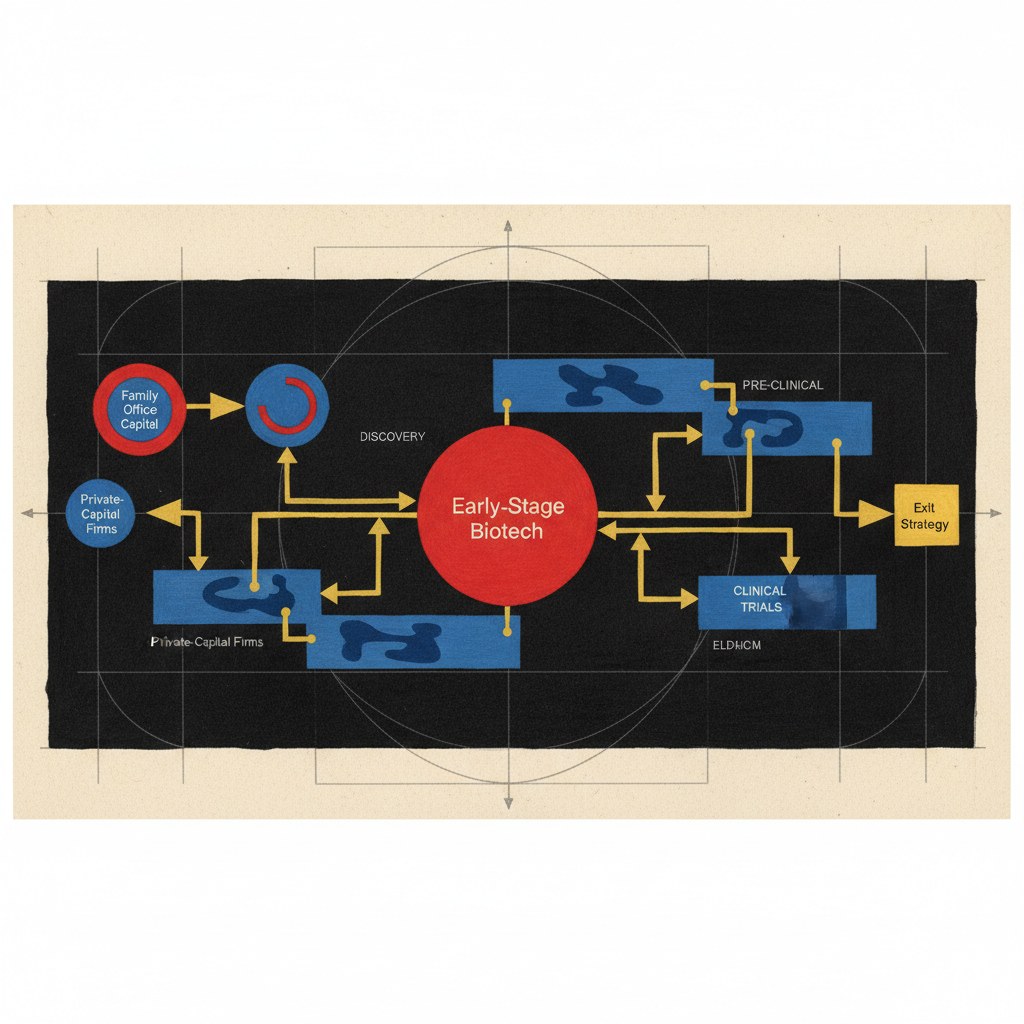
Editorial figure: The report's scale and Why Now argument rendered as a visual framework; the illustration provides context and does not represent measured data.
The Technology Deep Dive
Biotech investing is often described as science investing. That is true, but incomplete.
It is more accurately evidence-production investing.
A company does not merely own a technology. It must repeatedly generate information that changes the decision around a therapeutic hypothesis. Each experiment has two jobs: advance biological understanding and reduce uncertainty for the next financing, development, partnering, or regulatory decision.
The asset is a chain of proof
At formation, a scientific proposition may appear simple: a target, pathway, modality, disease mechanism, or platform may offer a route toward a useful intervention. Commercially, that proposition is only the first link in a longer chain.
The company must establish relevance, feasibility, measurement, and development logic; It must show why the mechanism matters, how intervention may be possible, what can be observed, and how the development plan can distinguish meaningful signal from noise.
The ledger does not provide clinical data for a named early-stage therapeutic program. No conclusion about efficacy, safety, probability of success, or therapeutic superiority belongs here.
Alethio’s reported financing is associated with rare blood cancer drugs, but the supplied evidence supports the funding event rather than a conclusion about a specific candidate’s mechanism, clinical stage, or likelihood of success; [1] The funding announcement is a capital signal, not a biological verdict.
The central diligence question is therefore not whether a technology sounds important. It is whether the company can produce the next dataset that meaningfully changes a decision.
What evidence can emerge? When can it emerge? Will it be legible to later investors, pharmaceutical partners, regulators, and clinicians?
A technically interesting dataset may fail to create financing momentum if it cannot resolve the question that matters next. A narrower but decision-useful dataset may create disproportionate value. In the relay race, the baton is not activity. It is interpretable evidence.
Signals are not substitutes for science
The study of 453 French new-technology ventures offers a useful, though non-biotech-specific, lesson. Strong structural signals such as patents or trademarks were positively associated with early-stage venture funding, while education and elite institutional affiliations could reinforce team credibility. [24]
Those findings should not become a biotech checklist. Patent count does not validate a therapeutic mechanism. Pedigree does not eliminate translational risk. A prominent advisory board does not establish clinical value.
Instead, the findings explain why investors may respond to observable evidence when technical diligence is difficult; Intellectual property can suggest that a company has defined and attempted to protect a scientific position. Team history can suggest familiarity with the path from discovery to development. Mentors, incubators, and early investors can suggest access to expertise.
These are scaffolding around the scientific building. They are not the building itself.
A family office that mistakes affiliation for validation can fail in the same way as a hurried institutional investor. The error is not unique to any capital class. It is a recurring risk where biological proof is difficult to assess.
The more useful diligence posture is additive rather than decorative. Each signal should answer a different question: Does the company have a defensible scientific claim? Does it have people capable of generating the next proof point? Does it have a financing plan matched to the work? Does its governance allow the original story to be challenged when evidence demands it?
The ledger’s warning about redundant signaling is especially relevant. [24] More information is not always more clarity. More indicators from the same category can raise cognitive load without improving the underlying decision.
Programs, platforms, and evidence burden
The evidence burden changes depending on whether a company presents a single program or a platform. A program-focused company may be judged on disease biology, development design, competitive position, and the quality of its next experiment.
A platform company carries an additional burden. It must show not only that one asset may work, but that its operating approach can repeatedly generate valuable assets. That requires proof of repeatability, not merely possibility.
The supplied material does not support a categorical ranking of platform companies over program companies, or the reverse. It supports the broader proposition that early-stage funding responds to credibility and legitimacy signals, while overlapping signals can lose value when they fail to add distinct information. [24]
A platform company should therefore resist building a tower of correlated claims; A broad technology label, elite founders, proprietary data, multiple targets, and a large theoretical opportunity may still fail to clarify the first investable experiment.
This is where family-office participation could become distinctive in theory. An investor with flexibility may be able to support a deliberate evidence sequence rather than demand the broadest possible story at the first financing. That remains an inference, not a ledger-verified behavior pattern. [14][19][23]
The practical discipline applies regardless of investor type: fund the experiment that makes the next decision easier. Do not fund the presentation that makes the current round sound larger.
Artificial intelligence belongs in the workflow
The ledger includes an Anthropic report describing early progress on accelerating drug development with Claude; [2] The supplied excerpt does not provide performance metrics, named partners, clinical outcomes, or evidence that artificial intelligence has reduced drug-development attrition.
AI should therefore not be. Treated as a verified shortcut through biology.
Its plausible role, based on the available evidence, is operational and analytical rather than magical. Drug-development work can involve large bodies of literature, protocols, records, and internal decision materials. Tools that help researchers and operators navigate information may improve coordination or documentation, but the ledger does not quantify those effects. [2]
The decisive proof remains biological and clinical; A language model may assist a research workflow. It cannot, on the supplied evidence, validate a therapeutic mechanism.
That distinction matters when capital becomes selective. AI claims can become another category of signal. Investors should ask whether the tool changes a decision process, creates a differentiated dataset, or improves the company’s capacity to learn. If the answer is simply that a company uses an AI tool, the claim may add noise rather than reduce risk.
The venture-signals research offers the caution. [24] A fashionable label can become another redundant signal if it does not answer an independent question.
Talent networks as translational infrastructure
Nucleate’s Activator is described as giving early-stage biotech founders skills, mentors, and investor connections to launch; [3] That description highlights an important reality: company creation is not only about money.
It is also about assembling an operating network around science before a company has extensive internal infrastructure. A founder may need help converting an academic insight into a company-ready proposition. An investor may need access to domain expertise, emerging talent, executive candidates, and diligence perspectives.
The ledger does not quantify Nucleate’s outcomes; It does not establish companies formed, capital raised, exits achieved, therapies advanced, or investment returns. [3] Still, the model reinforces the view that biotechnology formation depends on coordinated human capital as well as financial capital.
That creates a potential role for family offices and other private capital providers; Rather than competing solely on ownership percentage or check size, they may support the connective tissue around a company: expert access, patient governance, and a financing sequence designed around evidence.
Structure does not guarantee judgment. The relay team still needs to know who carries the baton, where the next exchange occurs, and what would change the race plan.
The handoff discipline
The relay-race metaphor returns because every technical milestone must be designed as a handoff. Discovery hands off to translational validation. Translational validation hands off to development planning. Development planning hands off to financing. Financing hands off to the next experiment.
The handoff succeeds when the next decision-maker can understand what changed and why it matters. This is not merely communication. It is capital discipline.
A company that cannot articulate the decision value of its next dataset risks spending scarce capital on experiments that generate activity without investable clarity. A capital provider that cannot distinguish meaningful de-risking from cosmetic progress risks financing the wrong kind of motion.
Technology and financing are therefore inseparable. Finance cannot manufacture biology. But financing cadence can influence whether biology receives enough time and structure to produce credible evidence.
The central distinction is patience versus complacency; Patient capital funds the next discriminating experiment. Complacent capital continues funding a story after its evidence has stopped improving.
Market Implications
The market implication is not that institutional venture capital is disappearing; The ledger contains evidence of active fundraising, founder support, and investor connectivity. [1][3]
The stronger conclusion is that the market may be differentiating more. Sharply between companies with decision-relevant evidence and companies relying on broad thematic appeal.
Scarcity creates a premium for legibility
When investors become more selective, companies do not simply need more data; They need data that answer the right question.
The venture-signals study indicates that legitimacy and credibility signals can matter, but redundant bundles of similar signals can reduce clarity. [24] In practice, an early biotech company needs a coherent evidence stack: a defensible intellectual-property position, a credible team, an explicit development plan, and a financing approach that acknowledges uncertainty rather than disguising it.
The market consequence is a premium for legibility; Companies that can explain why their next experiment matters may command attention even when capital feels scarce.
Alethio’s reported Series A offers one example of substantial financing persisting in the market. [1] The ledger does not establish why that round occurred, whether it reflects a broader benchmark, or what terms the company accepted.
The conclusion must remain narrow: capital has not vanished, but it may be concentrating around a smaller number of narratives considered sufficiently de-risked; This creates an uncomfortable but productive standard for founders: not every uncertainty must be resolved before raising capital, but critical uncertainties must be identified and matched to a credible plan.
Family capital may occupy the seam
Institutional-arbitrage theory is useful because it focuses on benefits that can emerge when actors engage across incompatible institutional logics. [23] In biotech, a family office may sometimes sit at the seam between a laboratory-originated venture, an institutional venture syndicate, a strategic pharmaceutical counterparty, and a longer-duration wealth-management mandate.
That is an analytical possibility; It is not proof of a current market-wide pattern.
Scientists may prioritize program integrity. Venture funds may prioritize portfolio construction, ownership, and follow-on capacity. Strategic buyers may prioritize fit with therapeutic priorities. Family capital may prioritize direct ownership exposure or long-duration wealth preservation.
These motivations can collide. They can also be arranged into a more resilient financing structure.
The danger is that “flexibility” becomes a euphemism for weak discipline. Family offices do not receive a free pass from adverse evidence, governance failure, technical risk, or execution error. Research on single-family-office-owned firms supports the existence of professionalized financing behavior and higher long-term debt ratios relative to traditional family-owned firms. [14][19] It does not establish that family-office governance is superior in life sciences.
A sophisticated capital structure can still support a weak scientific thesis. A longer horizon can still become a longer path to loss.
The formation layer becomes strategic
Founder-development programs matter because biotech companies can begin before they look institutionally complete; Nucleate’s Activator is explicitly positioned around skills, mentors, and investor connections for founders launching early-stage biotech ventures. [3]
This points to a formation layer in which company-building quality may influence which scientific ideas become financeable businesses. Sourcing and capability building become connected.
The investor who sees a company only at the priced-round stage may encounter a polished but crowded opportunity; The investor who participates earlier gains greater influence but also accepts more uncertainty around team construction, intellectual property, and development design.
That trade-off is where the arbitrage framework becomes useful. The objective is not to exploit founders’ lack of options. It is to recognize that capital can add value before it is large.
A thoughtful early participant may help identify a decision-critical experiment, recruit an operator, or build a financing path that preserves strategic flexibility. Those are plausible sources of value creation, not verified return drivers in the ledger.
KEY TAKEAWAY: In a selective funding market, the scarce asset is not capital alone but capital that helps convert scientific uncertainty into a legible next decision. [3][24]
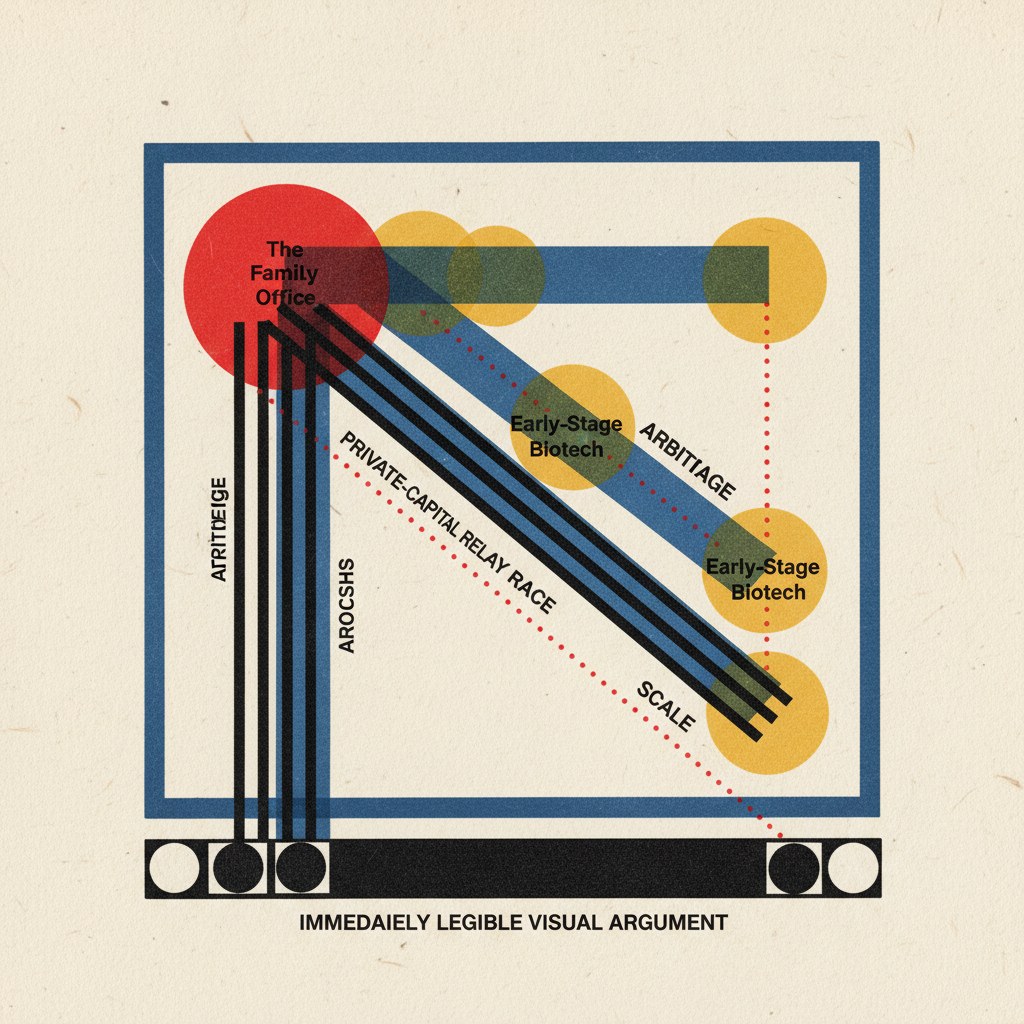
Editorial figure: The report's market-transmission and investment logic rendered as a visual framework; the illustration does not represent measured data.
The Competitive Field
The competitive field here is not a conventional public-equity leaderboard; The ledger does not provide verified tickers, market capitalizations, share prices, financing valuations, or options availability for the relevant organizations.
A credible comparison must therefore examine observable roles in. Company creation and early financing rather than inventing public-market proxies.
| Company | Ticker | Market Cap | Key Metric | Vetta Signal |
|---|---|---|---|---|
| Alethio | Not provided | Not provided | Reported $90M Series A for rare blood cancer drugs [1] | WATCH: financing validation, but no clinical or valuation data supplied |
| Nucleate Activator | Not provided | Not provided | Founder program offering skills, mentors, and investor connections [3] | WATCH: formation-layer access and network relevance |
| ALSA Ventures | Not provided | Not provided | Reported focus on lifting early-stage European biotechs [11] | WATCH: specialist orientation, with no performance data supplied |
Alethio: financing is a signal, not an outcome
Alethio is the clearest company-specific financing datapoint in the ledger. [1]
That matters because a large early-stage round can, in principle, provide room to pursue development-critical work without an immediate return to the market. However, it would be analytically reckless to turn that financing event into a clinical endorsement.
The supplied excerpt does not provide asset stage, mechanism of action, trial design, efficacy data, safety profile, investor syndicate, valuation, or ownership structure; [1] It also does not establish whether family offices participated, whether billionaire capital led the round, or whether the financing displaced institutional venture capital.
The positive implication is bounded: substantial early-stage biotech financings remain possible. The negative implication is equally clear: a headline round can create visibility that later evidence may or may not justify.
Alethio therefore merits a WATCH designation as a market signal rather than an investable public-security conclusion. The funding validates the existence of capital commitment. It does not validate the drug.
Nucleate Activator: the company-creation competitor
Nucleate Activator is not presented in the ledger as a therapeutic developer; Its relevance lies in company formation. BioBuzz describes the program as giving early-stage biotech founders skills, mentors, and investor connections to launch. [3]
That makes it a competitor for access and attention rather than drug-market share. Its positive strategic impact is that it may narrow the gap between promising science and venture readiness. Founders can gain structured exposure to mentors and investors before they have built a mature company organization. [3]
For family offices and other early capital providers, such programs may improve sourcing and diligence by concentrating emerging teams and talent. That is an inference from the program’s described function, not a verified investment outcome. [3]
The limitation is plain. The ledger supplies no performance metrics. It does not verify a count of companies formed, capital raised, exits achieved, therapies advanced, or returns produced through the Activator. [3]
Nucleate represents venture-formation infrastructure. It does not, on the evidence supplied, represent validated proof of superior investment performance.
ALSA Ventures: the specialist-capital comparator
ALSA Ventures appears in a 2023 GEN Edge item described as lifting early-stage European biotechs “out of the gate;” [11] The ledger does not provide fund size, portfolio composition, investment results, deployment statistics, or named portfolio-company outcomes.
Its inclusion serves a narrow purpose. It illustrates that specialized early-stage biotech capital structures exist outside a generic venture-capital category. [11]
The positive signal is specialization. A specialist may be better positioned to assess a technically demanding opportunity than a broad generalist. The negative signal is opacity.
A specialist mandate is not evidence of superior selection; The difference between informed specialization and thematic promotion depends on diligence quality, portfolio construction, follow-on capacity, and realized outcomes. The supplied excerpt does not establish those factors. [11]
The real competitive contest
The table points to a more useful competitive frame than a list of market caps. Alethio represents the funded therapeutic company. Nucleate represents the formation network. ALSA Ventures represents the specialist-capital channel. [1][3][11]
Family offices are not automatically a fourth and superior category. They are potential participants that may bridge these roles if they bring distinct time horizon, expertise, governance, or relationship continuity.
That is where family-office arbitrage can become substantive rather than rhetorical; A family office may find value not by competing head-on with every institutional venture firm, but by participating where the institutional process has a structural blind spot: a company too early for broad syndication, a formation team needing operational support, or a financing plan requiring more patient sequencing.
This remains an inference supported conceptually by institutional-arbitrage theory and family-office capital-structure research. [14][19][23] It is not a verified deal-flow pattern.
Any advantage must be earned through process; It requires scientific diligence capable of rejecting weak stories, governance capable of challenging founders constructively, and reserve discipline capable of separating a necessary follow-on from sunk-cost behavior.
Wealth alone is not a moat. In biotechnology, a large check without a decision framework can simply finance a larger mistake.
Investment Thesis
The investment thesis is narrower than the title’s provocation. Family-office capital may be positioned to capture selective early-stage biotech opportunities when it provides patient, evidence-driven financing across institutional boundaries. That is a conditional thesis, not a verified statement that billionaire capital broadly outperforms or front-runs institutional venture capital. [14][19][23]
Bull case
The bull case begins with selectivity. [1] Reporting on funding strain in another biotech setting suggests that companies outside prevailing institutional filters may encounter a financing gap. [4]
A disciplined family office could, in theory, address part of that gap by financing companies with enough evidence to support a clear next milestone but whose timing, ownership needs, or financing structure do not fit a conventional venture model; Institutional-arbitrage research supports the logic of finding value across differing value systems and practices. [23]
Family-office research supports the possibility of professionally managed and strategically structured capital rather than exclusively relationship-driven decision-making. [14][19] The bull thesis does not require family offices to replace venture capital. It requires them to complement it.
They may act as early-conviction capital, participate in a syndicate, bridge a company toward a larger financing, or support a formation-stage enterprise that needs operational help as much as money. The value arises from the handoff: helping a company reach the next proof point with less financing friction and greater decision clarity.
Bear case
The bear case is formidable; First, the ledger does not verify that family offices possess superior biotech diligence, better returns, larger allocations, or more favorable entry valuations than institutional venture funds.
Second, drug development remains scientifically uncertain regardless of investor patience. A longer time horizon can absorb delay. It cannot convert a flawed hypothesis into a viable medicine.
Third, flexibility can weaken discipline; Capital without rigorous underwriting can become vulnerable to prestige signaling, narrative momentum, and repeated follow-ons after evidence deteriorates. The venture-signals research warns that overlapping signals can create cognitive overload rather than stronger conviction. [24]
That warning matters in biotech. A celebrated founder, a prominent advisor, a patent estate, and an AI narrative may all point in the same direction without independently validating biology. The apparent strength of the story can become its most dangerous feature.
Conviction, valuation limits, and invalidation
Vetta’s conviction is moderate on the framework and low on broad performance claims. The evidence supports the proposition that institutional differences can create arbitrage opportunities, that family-office-owned firms may exhibit professionalized financing behavior, and that biotech formation depends on complementary signals and networks. [14][19][23][24]
The evidence does not support a sector-wide conclusion that billionaire capital is winning a race against institutional venture capital. It does not support claims of persistent family-office alpha in biotech. It does not support a public-market trade.
Valuation analysis is not possible from the supplied ledger; No verified market capitalizations, enterprise values, financing valuations, revenue figures, cash balances, clinical probabilities, or security prices are provided for the compared entities. No price target, target multiple, LONG recommendation, or SHORT recommendation is justified.
The thesis would be invalidated in practice if flexible capital repeatedly failed to improve the quality of the evidence sequence, governance, or financing resilience relative to conventional structures; It would also weaken if supposed patient capital became indistinguishable from undisciplined follow-on funding.
Catalysts, if they emerge, would need to be concrete and verifiable: credible funding events, disclosed development progress, stronger syndicate composition, or evidence that a company has resolved a decision-critical uncertainty. The ledger does not provide enough company-specific information to identify such catalysts for a named security.
KEY TAKEAWAY: The thesis works only when flexible capital remains more disciplined than the institutional constraints it seeks to exploit. [14][19][23][24]
Challenges & Risks
The first risk is scientific; Biotech assets live or die by evidence, and the ledger provides no basis for claiming that patient capital changes therapeutic probability of success.
A better financing structure can improve a company’s ability to run the right experiment. It cannot guarantee that biology will cooperate.
The second risk is selection. Early-stage companies are difficult to compare because important information may be private, preliminary, or technically complex. The venture-signals study helps explain why investors rely on observable markers of legitimacy and credibility. [24]
But a signal is not a substitute for causal understanding; Patents, pedigrees, mentors, and sophisticated investors may all matter without proving that a therapy will work. The decisive question remains whether the next experiment can challenge or strengthen the core biological claim.
Concentration risk
Family offices can face concentrated-exposure risk if direct biotechnology investments occupy too much of a private-capital portfolio. The ledger provides no allocation guidance, historical loss ratios, or portfolio-construction benchmarks. No optimal concentration level can be responsibly specified.
Still, a single early-stage biotech position can carry linked scientific, financing, regulatory, and execution risks. Concentration becomes more dangerous when an investor confuses access with advantage.
Being offered an early round does not establish that the opportunity is mispriced. The need for unusual capital can sometimes indicate that conventional investors found the risk difficult to underwrite. That is not automatically negative. It is a prompt for deeper diligence.
Governance risk
The research on family-office-owned firms characterizes financing decisions as more influenced by professional wealth-management strategies than emotional or social connections, relative to traditional family-owned businesses. [14][19] That is encouraging at the category level, but it should not be stretched beyond the evidence.
A family office can still be shaped by founder affinity, social proximity, reputation concerns, or enthusiasm for a prestigious scientific venture. Professionalization is a possibility. It is not immunity.
Good governance asks uncomfortable questions before the company needs another check. What evidence would change the investment view? Who has authority to stop funding? How will follow-on decisions be separated from the desire to protect an earlier investment? Which independent experts can challenge the original diligence?
The ledger does not prescribe the answers. The questions follow from the uncertainty built into the asset class.
Regulatory and policy risk
The supplied material includes concern that U.S. policy choices could affect biotechnology competitiveness and early research relative to China. [5] It also includes commentary warning that congressional action could undermine North Carolina’s biotechnology momentum. [7]
These are policy-framed or opinion-oriented sources, not quantified forecasts; They support recognition that public policy, regulation, research competitiveness, and regional conditions can influence biotechnology capital formation. They do not support a precise forecast of legislative outcomes.
Policy risk matters because drug development depends on more than private checks; Research institutions, clinical sites, regulatory processes, workforce availability, and intellectual-property rules can shape the path from scientific claim to therapeutic product.
A family office may finance a company. It cannot insulate that company from the wider operating environment.
Exit and implementation risk
The final risk is realization; The ledger does not provide exit data, acquisition multiples, IPO conditions, or secondary-market information.
The exit pathway must therefore be treated as unverified. This sharply constrains the arbitrage label.
An investor may identify an underappreciated formation-stage company, fund the right experiment, and still face poor liquidity conditions later. Scientific success and investment success are linked. They are not identical.
Implementation risk compounds the problem; More private-company information does not guarantee better understanding. A diligence team must be able to interpret scientific claims, challenge assumptions, and identify what has not been shown.
The Investment Angle
The actionable angle is process, not prediction; The ledger does not support public-security recommendations, listed-options strategies, or a claim that a specific family office offers a superior biotechnology vehicle.
The appropriate stance is WATCH. Focused on the structure of private opportunities rather than unsupported ticker-based positioning.
Build a decision ledger before writing a check
A family office or private-capital investor should begin with a decision ledger that separates verified facts from inferences; Verified facts may include a disclosed financing announcement, a stated development plan, an intellectual-property position, leadership history, or a publicly described milestone.
Inferences include whether the asset has a durable edge, whether a syndicate will support later rounds, whether a strategic buyer will care about eventual data, and whether the company’s financing plan matches the duration of its scientific work. The distinction is essential because early-stage biotech stories blend hard evidence with persuasive extrapolation.
The venture-signals research explains why a balanced evidence portfolio can support funding, while also cautioning that redundant signals can obscure judgment; [24] A strong diligence process should classify each claim as scientific evidence, structural evidence, team evidence, market assumption, or financing assumption.
The objective is not certainty. It is to isolate the next decision-critical uncertainty.
If the central question is biological validity, fund the experiment that addresses biology. If the question is translational feasibility, fund the experiment that tests translation. If the question is leadership capability, solve the leadership gap rather than pretending another presentation can answer it.
Prefer complementary syndicates
The best syndicate is not necessarily the largest or most famous. It is the group in which participants bring different but relevant capabilities.
One investor may understand the disease area. Another may support company building. Another may have later-stage financing capacity. A founder-development network may provide skills, mentors, and investor connections, as Nucleate’s Activator is designed to do. [3]
This is where family capital can be useful without claiming to substitute for specialist venture capital. It may provide duration, relationship continuity, and flexibility while relying on scientific specialists for diligence and venture partners for portfolio pattern recognition.
That structure may reduce the risk of a single capital provider overstating its competence. Institutional-arbitrage theory supports the potential value of combining distinct purposes, practices, and legitimacy systems. [23] The combination works only when roles and authority are explicit.
Ambiguous governance turns diversity of perspective into delay. Clear governance turns it into a better handoff.
Treat round size as a question
[1] It should be interpreted as evidence that a substantial commitment was made, not as independent proof of clinical merit.
A large round can allow parallel workstreams and reduce short-term fundraising distraction. It can also increase expectations and make subsequent financing more difficult if evidence fails to match the implied ambition.
The underwriting question is not, “How much was raised?” It is, “What decision sequence does the capital purchase?” A disciplined investor should map financing to concrete gates: studies required, evidence expected, team additions needed, and contingency plans if the original hypothesis weakens.
The ledger does not provide company-specific budgets or milestones for Alethio. This remains a general underwriting framework, not a recommendation about the company. [1]
Implementation discipline remains high
Implementation risk begins with information asymmetry; Private-company investors may receive more information than public observers, but more documents do not necessarily create better understanding.
The diligence team must interpret scientific claims, challenge embedded assumptions, and recognize missing evidence. It must also distinguish a meaningful evidence handoff from an attractive but repetitive story.
Follow-on risk is equally important. An initial investment can create pressure to participate in subsequent rounds. Without reserve policies and stopping rules, a rational initial decision can become a sequence of defensive commitments.
The family-office evidence supports professionalization as a possibility, not protection from this problem. [14][19] The clearest discipline is to define in advance what evidence would justify another check and what evidence would end the commitment.
Listed options are not verified for any relevant security in the ledger. No options spreads should be inferred or constructed. Options implementation is therefore omitted.
Future Outlook
The next phase of early-stage biotech financing may be defined less by a simple return of abundant capital than by sharper distinctions between capital that merely funds activity and capital that funds learning. The ledger supports continued formation activity, continued investor connectivity, and at least one substantial early-stage financing event. [1][3]
It also supports the view that funding conditions can become difficult enough to prompt organized efforts to support early drug financing; [4] That tension is likely to keep the family-office question alive.
When conventional venture capital becomes highly selective, long-duration private capital may become more relevant to founders operating between scientific promise and institutional readiness. When institutional capital becomes more available, family offices may still matter as co-investors, formation partners, or sources of patient governance.
Neither outcome requires the simplistic conclusion that one capital class has defeated another. The capital stack is not a winner-take-all race. It is a sequence of handoffs, and every participant must add something the next participant can recognize.
The decisive variable will be underwriting quality; Institutional arbitrage can create opportunity when an investor recognizes real differences in time horizon, valuation logic, operating practice, and legitimacy. [23] It becomes dangerous when those differences are treated as proof that ordinary diligence no longer applies.
In biotech, the scientific handoff remains sovereign; Each round of capital must buy evidence capable of surviving scrutiny from the next expert in the relay.
For founders, the lesson is to build complementary signals rather than an overloaded story. Research on early-stage venture funding suggests that patents, trademarks, and credible teams can matter, while redundant signaling can reduce clarity. [24]
A company should make it easy for capital providers to understand what is known, what remains uncertain, and what the next financing will accomplish. The goal is not to eliminate uncertainty. It is to make uncertainty investable.
For investors, the lesson is equally direct; The attractive opportunity is not access to billionaire capital, nor access to a fashionable therapeutic theme. It is the ability to identify a company where the next experiment is both scientifically discriminating and financially legible.
That is the private-capital relay race worth running: not faster than institutional venture capital for its own sake, but with enough discipline to carry a credible scientific baton through the next gate.
Sources & References
- Fierce Biotech. "Fierce Biotech Fundraising Tracker '26: Alethio attains $90M series A for rare blood cancer drugs - Fierce Biotech." Thu,. https://news.google.com/rss/articles/CBMigAFBVV95cUxPWnNIYUVmZkJnUzFkM3dqNFpZaFZRRUdTUWNxb2lMeDY4NklMMGJobEM0NDU3LUQ2ZmRhYjNNaTlRM3N4MzZHOExoV3BGQXk1a1dKNDFHaHlrT0RZX3pYd0g0OVhlNnZobEtEdzBtLTh3ZnRsSWFpbGNjRVVpU1VIMA?oc=5
- Anthropic. "Early progress on accelerating drug development with Claude - Anthropic." Tue,. https://news.google.com/rss/articles/CBMidEFVX3lxTE5IbmplZ01nQUt5R0hldklCR3FRMlVWZy1RcFZlc1VpRDhVNk00Vzd0Mm5QdlNXb1NncmxTX1ZFZTl4Xzl5bkpqUU56OGVxWjlZWmN6SjM4cVFLX3dkU0RUNWJVQ1JZTUswTk1iSzJ1MGwyUldn?oc=5
- BioBuzz. "Nucleate’s Activator Gives Early-Stage Biotech Founders the Skills, Mentors, and Investor Connections to Launch - BioBuzz." Mon,. https://news.google.com/rss/articles/CBMizgFBVV95cUxORHZPcFJxV3NXaURzSEhsU0xXdTNZNGt0WTZIR29GZ2tjcWgxX3NiQmw1ajlTMVltMF8yazJFM1Myb3Zqc1dON05XNS14TXJ1YzQtc2N4Qy1Ybll4TDFBMDJUVDMyeUtNVXhWcTkzVlRoU1M4alJsSnVEQkNXUHBlRlhNZWNuMVhrR0VmMUN2RWYtNzJDbkMzd01kclBNdmxNNC1aMk1QNmgyOEFtSi1OOThfMkdrdXcxLXhTRHA3V0VTQVVRbjJSVjZVNzV1Zw?oc=5
- The Times of Israel. "As investors dry up, national biotech hub aims to transfuse early-stage drug funding - The Times of Israel." Tue,. https://news.google.com/rss/articles/CBMitAFBVV95cUxPV3RMVllCa3ZCWnhjYUdZVjdFQ3lVeDJVWjdTbGRXRk44V1g2MWlXM2JNRDlRVFNMeUxkS0pEM2dIRE9tdEM2ZW93ZG0tV1h5ckE4d1RfZldsS1dYOWMwdk9kWDdyYTdSd1hFOTlzNjZBc05sX1pIQTFhSXlJTTVwZzJHbFJIY0tDY2I1ejdiZDlyemFNLXBxMHlRMi01aVI0anBkRFJkdHI5R3luWjhZV2dzZWjSAboBQVVfeXFMT1psVnBROHZSc0hub0RBaWRrUzlEVURzNVNZcmpLUlR6N2VaTE5GR0JaU3NnQ2x5VlRyUUhjazBiejhEZjZ4WG10QVN1UXlwX3Y3TV9zQmMwdG12by1YOTdLNEozWjEtakowSGJ4bnZBbHo1SVpETEdDa1ZWUDVyVGdtT3ltLTFVaDl1SE5OUWJMcmlnSVQxdE9wOTgxX0RfZnZGNlRQQzdvX2lobkx4enluVDhUZ0hvZHBn?oc=5
- BioSpace. "Opinion: The FDA must put biotech at its center or continue to cede early research to China - BioSpace." Mon,. https://news.google.com/rss/articles/CBMiuwFBVV95cUxQN3dHUDJiSjNQMDJmanI3dzFZV3lJUDd5emNYTy1vTGh1SDVkQlpDekJSanZlS0ZkTHUzSUdObUYwdGk1dzZucFdWNGVkeGVDZmxYNVV2azBfNFFmQ2xFMG5TdlU3VDdhN1B1ZWZuNnpCNEZOem9FVWFmTzBheG5pRGdnWW0tZXkzUmt2cEpHbzE4M0VqVzVjNmkzU19pOW1CRXBKWnQwbzNJMGFhWk5DUUJBZUpLbUpyeWRB?oc=5
- Morningstar. "The Best Biotech Stocks to Buy - Morningstar." Mon,. https://news.google.com/rss/articles/CBMiakFVX3lxTE1LVzQxbTd5SlM0VzVDWWU4dGxVUUk1SGFkc3RncGc4OFB5dTJfN1VQS3pzVGVWV3RtZjJ5NHBRc3FqLVBBTmMzS2pKRkxiQXhEeEhPWGs2ejVmTlRQUkZiRDhaTmg1TVNpRmc?oc=5
- Carolina Journal. "Congress could undermine NC’s biotech boom - Carolina Journal." Tue,. https://news.google.com/rss/articles/CBMiigFBVV95cUxOTWh0LXJ3ODJKeTJKU0xEZUJsS2plZFBKbVBFa29XYi1JMzJkQTRPUkVEQlhVYl9pcDdYS2hBeTQxZjJPUGN5T0JKc3RCcEhPZHJNU1hjcEhhQXZBQWJsMTUyZmkyeEcwckQybEpuSzZRODJFRTg5MGJsdHlvWldKNEMzcTVaUmRBemc?oc=5
- STAT. "Pharma and biotech leaders are destroying their own industry - STAT." Tue,. https://news.google.com/rss/articles/CBMipAFBVV95cUxOaWFsSEV1T0tzZkdmX19qRlpNWVJaT1FhUThPXzBzWE1PbVZJcjdmOHJDOURmUXgzTG1NZkt6TFhWSld3Z1pnQTFHcmNWdlFxaVJ5M2ZUVTk5b0VKVnU2NldjWER2R01KR2N5OGpmQWF0TTM3bGM1cmlYeDM3UHRTaGtuMkluYlhmRnRzNVJiNTlMYjNCWGowUUN1OERrejQzRDlDeQ?oc=5
- Journal of Economic Criminology. "Credible openness in international family-office hubs: Regulatory arbitrage, capital selection and financial integrity." 2026. https://doi.org/10.1016/j.jeconc.2026.100257
- Frontiers in Sociology. "Erratum: Flexibilizing the Retirement Transition: Why, How and for Whom? Conceptual Clarifications, Institutional Arrangements and Potential Consequences." 2022. https://doi.org/10.3389/fsoc.2021.845393
- GEN Edge. "On Your Mark: ALSA Ventures Lifts Early-Stage European Biotechs to Jockey Out of the Gate." 2023. https://doi.org/10.1089/genedge.5.1.130
- Frontiers in Oncology. "Erratum: Estimation risk of lymph nodal invasion in patients with early-stage cervical cancer: Cervical cancer application." 2023. https://doi.org/10.3389/fonc.2023.1178841
- Frontiers in Environmental Science. "Retraction: Greening the globe: a multi-stage analysis of human capital, innovation-policy interactions, and renewable energy in driving environmental sustainability." 2026. https://doi.org/10.3389/fenvs.2026.1953120
- Spotlight by CeFEO. "Do family office-owned firms take more financial risks?." 2024. https://doi.org/10.68623/spotlight.2025.3f6
- Small Business Economics. "Governors’ Tenure and Venture Capital Firms’ Early-stage Investing: A Subnational Institutional Perspective." 2025. https://doi.org/10.1007/s11187-025-01005-6
- BioTech. "Acknowledgment to Reviewers of BioTech in 2021." 2022. https://doi.org/10.3390/biotech11010002
- BioTech. "Acknowledgment to the Reviewers of BioTech in 2022." 2023. https://doi.org/10.3390/biotech12010011
- Class, Race Corporate Power. "The Institutional Drivers Contributing to Billionaire Wealth at the Sector Level." 2023. https://doi.org/10.25148/crcp.11.1.010593
- Journal of Family Business Strategy. "Capital structure of single family office-owned firms." 2024. https://doi.org/10.1016/j.jfbs.2023.100596
- Frontiers in Oncology. "Beyond the platform: why surgical quality and surgeon proficiency outweigh the RATS vs. VATS debate in early-stage lung cancer." 2026. https://doi.org/10.3389/fonc.2026.1896248
- Frontiers in Neuroinformatics. "Retraction: NeuroSuites: an online platform for running neuroscience, statistical, and machine learning tools." 2024. https://doi.org/10.3389/fninf.2024.1376953
- Entrepreneur and Innovation Exchange. "AI in Family Business: Why Brain Capital Is Your Real Competitive Advantage." 2026. https://doi.org/10.32617/1368-69a0627a49e4c
- Organization Theory. "Institutional Arbitrage: How Actors Exploit Institutional Difference." 2022. https://doi.org/10.1177/26317877221090313
- M@n@gement. "Interplay of Human and Structural Capital Signals for New Technology Ventures in Early-Stage Venture Capital Funding." 2026. https://doi.org/10.37725/mgmt.2026.10762
All sources were verified at the time of publication.
Disclaimer: The information provided in this article is for educational and informational purposes only and does not constitute investment advice. A solicitation, or a recommendation to buy or sell any security; Vetta Investments does not guarantee the accuracy, completeness, or timeliness of any information presented.
Past performance is not indicative of future results. All investments involve risk, including the possible loss of principal. Readers should conduct their own due diligence and consult a qualified financial advisor before making any investment decisions. Vetta Investments may hold positions in securities mentioned in this article.