The Control-Room Premium: Why Real Assets Are Moving Beyond Passive Ownership in 2026
TL;DR: The Vetta Framework
- Core Thesis: The investable question in real assets is shifting from who owns an asset toward who can connect ownership, operating data, maintenance decisions, and lifecycle capital allocation in one accountable system. [11][14]
- Key Data Point: research infrastructure. [3]
- Market Implication: Integrated infrastructure platforms may deserve greater strategic attention than passive structures when they improve coordination across condition monitoring, project delivery, risk management, and portfolio decisions. [11][14]
- Primary Risk: A connected platform can create governance friction, opaque dependencies, and valuation errors when investors confuse a larger data stack with a proven economic advantage. [16][18][22]
- Action Signal: The evidence ledger does not verify public-company valuations, market capitalizations, financials, or listed-options availability, so security-level implementation remains conditional.
Passive ownership offers a clean proposition: own the asset, collect the contractual cash flow, refinance when conditions allow, and delegate operations. That model can remain useful where contractual rights are clear and operating accountability is credible. The supplied evidence, however, points toward a harder question: what matters when cash flow depends on data quality, maintenance timing, climate exposure, capital-project sequencing, and the authority to act before a manageable problem becomes a costly failure? [11][14]
The relevant asset is not simply “technology.” It is the control room: the operating layer that links physical condition, risk signals, maintenance priorities, project decisions, stakeholder coordination, and capital allocation. Railway research describes the challenge directly. Operators face aging infrastructure and climate-related risks, while organizations can struggle to convert varied data into cohesive, decision-supporting risk prioritization. [11]
That distinction changes the ownership debate; A passive stake can provide economic exposure while leaving the owner several steps away from information that shapes availability, maintenance quality, compliance posture, and renewal spending. Integration does not eliminate those risks. It changes who can see them early, who can assign responsibility, and whether the response operates as a connected system rather than a queue of separate contracts.
Forward-ownership research offers a narrow but useful clue. Within its modeled conditions, forward ownership can lower intermediate-input prices, mitigate double marginalization, and increase aggregate output. [10] That is not a universal instruction for infrastructure investors. It is evidence that ownership structure can change incentives, not merely cap-table labels.
The real-asset shift is therefore not about abandoning rail, property, barriers, networks, or other physical assets. It is about abandoning the comforting fiction that a physical asset can be separated cleanly from the data, operating processes, and governance arrangements required to keep it productive.
The Landscape
Real assets are operating businesses wearing financial clothing. Railway infrastructure requires inspection, maintenance, dispatch coordination, and responses to heat, flooding, scour, and wind-driven debris. [11] The evidence ledger also includes research focused on asset management for storm-surge barriers, reinforcing that physical infrastructure requires continuing management rather than static ownership alone. [20]
Passive ownership abstracts from that operating reality; It can work when responsibilities are delegated effectively, reporting is reliable, and the owner’s principal task is capital allocation. The abstraction becomes fragile when performance depends on rapid feedback between physical conditions and managerial action.
This is where integrated infrastructure platforms enter the frame. The phrase should not be mistaken for a promise that every vertically connected organization is superior. It describes a structure in which more of the value chain sits inside, or is tightly coordinated by, a common operating and decision-making system.
The relevant links can include construction projects, operational assets, maintenance planning, portfolio oversight, data capture, and risk governance. Research on relationally integrated value networks extends asset-management thinking beyond a single asset toward total portfolio management involving both ongoing construction projects and operational built assets. [14] The important point is not full ownership of every activity. It is whether lifecycle decisions are connected where fragmentation would otherwise impose costs.
The control-room metaphor clarifies the distinction. A passive owner may own a ticket on the train. An integrated platform tries to operate the signals, inspect the track, schedule the repair crew, and decide whether the next mile of rail deserves capital. The attraction is not technological theater. It is the possibility of making better decisions before small failures become large obligations.
Data infrastructure strengthens that possibility. research infrastructure. [3] UC San Diego’s National Data Platform award concerns AI-ready data infrastructure, while Fermilab describes storage infrastructure as enabling AI-driven scientific and research discovery. [2][5]
For real assets, the inference is cautious. If data becomes part of asset operation, the system governing data quality, access, interoperability, and action pathways may matter as much as the system collecting rent or concession revenue. That does not establish that every sensor deployment creates financial value. It does establish that the old division between “the asset” and “the operating system around the asset” is becoming less useful.
The evidence also rejects a simplistic digital-versus-physical framing. The ledger includes research asking whether digital platforms function as urban infrastructure, while research on real-world asset tokenization describes a movement from experimental solutions toward financial infrastructure. [17][18] That tokenization research also identifies fragmentation in architecture, regulatory compliance, and institutional readiness. [18]
The sharper distinction is between passive exposure and active coordination. Passive exposure can own a share of an outcome. Active coordination seeks influence over the processes that create that outcome. The potential premium belongs not automatically to the asset with the most polished presentation, but to the operator that can turn condition evidence into disciplined capital decisions.
KEY TAKEAWAY: The real-asset pivot is a shift from owning the endpoint to governing the operating chain that determines whether the endpoint remains productive.
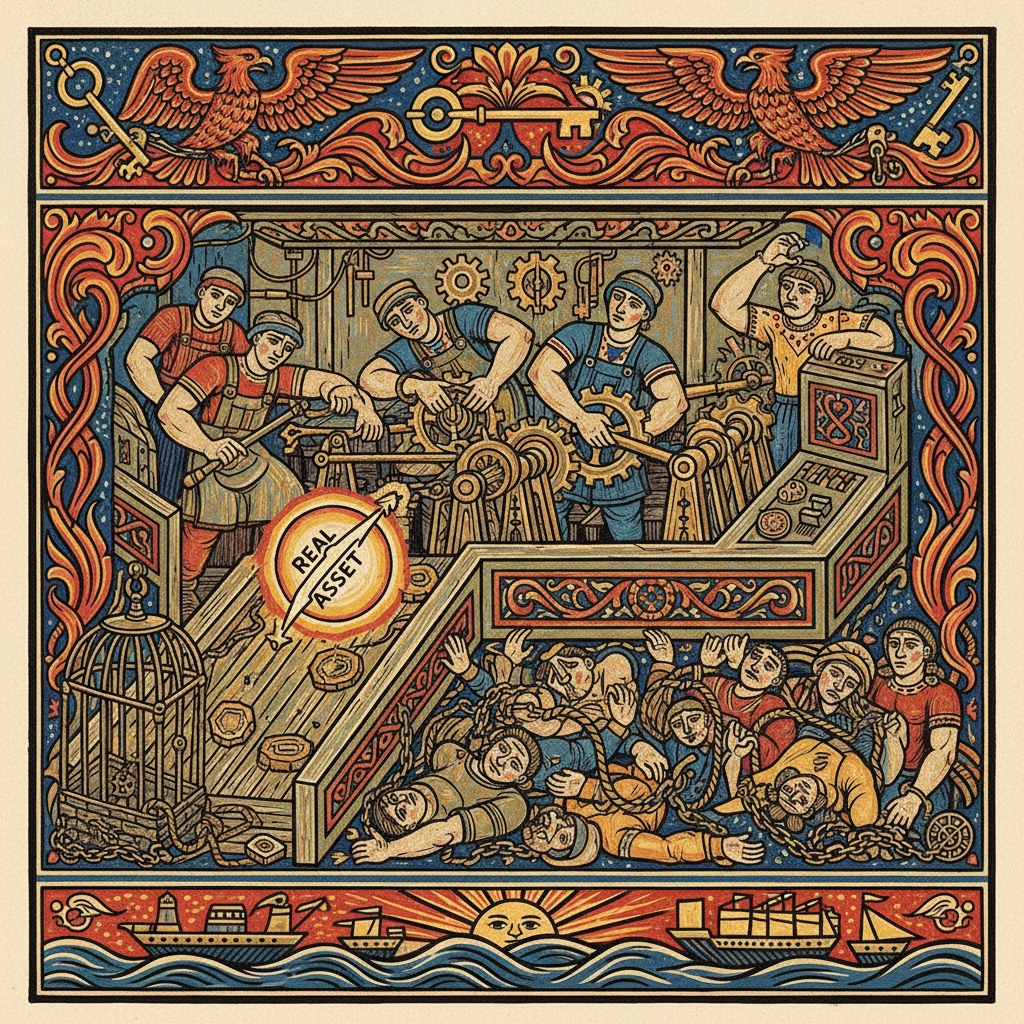
Editorial figure: The report's scale and Why Now argument rendered as a visual framework; the illustration provides context and does not represent measured data.
The Technology Deep Dive
The technology case begins with a stubbornly ordinary task: determining what condition an asset is in, what could damage it, and which action deserves priority. That task becomes difficult because infrastructure can produce different data types at different speeds and with different degrees of reliability. Inspection records, sensor signals, work orders, climate-linked hazards, project status, financing limits, and stakeholder obligations do not arrive as one clean ledger.
Railway infrastructure research captures the problem; It identifies aging assets and climate-related failure risks, while noting that organizations can struggle to turn data variety into cohesive, decision-supporting risk prioritization. [11] Its proposed framework combines wireless sensor networks, analytics for remaining useful life, risk-aware management planning, and a climate-vulnerability context layer. [11]
The sequence matters; Sensors create observations. Analytics translate observations into estimates. Risk models rank consequences. Management systems assign responsibility and spending. A platform becomes economically relevant only when those steps connect.
Consider the gap between a temperature signal and a maintenance decision. A sensor may identify heat exposure, but it does not decide whether an operator should inspect a component, impose restrictions, replace an asset early, defer another project, reroute activity, revise a contingency plan, or raise capital for a renewal program. An integrated platform attempts to connect the alert to the people, budgets, contracts, and operating rules that determine the response.
That is why “AI-enabled infrastructure” is too broad to carry an investment thesis by itself; The evidence supports AI-ready and AI-driven data infrastructure in research settings. [2][3][5] It does not establish that every AI application improves real-asset economics.
From Data Exhaust to Asset Health
A useful operating platform treats data as evidence rather than decoration. The railway framework incorporates continuous risk analysis, remaining-useful-life analytics, and climate-specific vulnerabilities including heat buckling, flood and scour, and debris from windstorms. [11] Those mechanisms connect physical condition to operational and financial consequences.
An owner with scattered systems may know that maintenance occurred without knowing whether it addressed the most material failure pathway. A more integrated platform can, in principle, compare risks across a portfolio using a common decision logic. The objective is not to remove judgment. It is to make judgment traceable.
That traceability matters when capital is scarce; Repair, renewal, expansion, resilience work, and delay all compete for the same budget. A condition score can mislead if it ignores climate exposure, asset criticality, or the consequence of failure. A risk-adjusted health index attempts to combine these considerations into a decision-supporting framework. [11]
The caveat is substantial; A composite score can create false precision when inputs are incomplete, assumptions become stale, or risk thresholds reflect managerial preferences more than objective conditions. The control room is valuable only if users can trace the headline score back to the underlying evidence and challenge it.
The Integration Layer
Research on relationally integrated value networks supplies another architectural clue. Its total-portfolio-management perspective links project management and asset management across the lifecycle, extending beyond one asset to a portfolio of construction projects and operating built assets. [14] This matters because capital projects and existing operations can compete for the same funding while being evaluated through separate institutional lenses.
An integrated platform attempts to reduce that divide. The construction team may be planning an upgrade while operations manages current performance. Asset managers may estimate lifecycle costs while finance focuses on funding capacity. Without a shared framework, each group can optimize locally while weakening the wider portfolio.
Integration does not require full corporate ownership of every contractor, supplier, lender, or technology provider. It requires coherent decision pathways. Vertical integration can be organizational, contractual, data-driven, or a combination of all three.
The ledger does not support treating those forms as equivalent; It does support the proposition that lifecycle coordination has practical potential for total portfolio management. [14] The investor’s work is to identify which links actually govern availability, maintenance quality, compliance, cost, and renewal capacity.
AI-Ready Does Not Mean Investment-Ready
The NSF, UC San Diego, and Fermilab evidence supports a broad trend toward integrated, AI-ready data infrastructure; [2][3][5] Translation from research infrastructure to real-asset returns remains an inference, not a verified financial outcome.
A platform must clear several tests before its technology deserves strategic value; Data must be reliable enough to support a decision. Data must move across organizational boundaries without dissolving accountability. Model output must reach an operator able to act. The action must be economically justified. Management must learn from results rather than preserve a stale model because replacing it is inconvenient.
The fourth test is often decisive. Predictive capability can identify more possible interventions than a capital budget can support. A platform that produces maintenance alerts without helping rank trade-offs may increase noise rather than resilience. The value lies in decision quality under constraint.
Tokenization as a Separate Rail Line
Tokenized real estate and broader real-world asset tokenization add a separate layer to the ownership debate. Research on tokenized-real-estate platforms finds that perceived liquidity, smart-contract automation, and decentralized participation are positively associated with psychological ownership, satisfaction, and continuance intention among surveyed users. [15] Comparative research on real-world asset tokenization argues that institutional implementation is complicated by fragmentation in architecture, regulation, and institutional readiness. [18]
These findings suggest that digital ownership interfaces can alter participation and investor behavior; They do not show that tokenization solves physical asset management. A fractional token can expand access while leaving maintenance, engineering, insurance, operating performance, and governance exactly as difficult as before.
Tokenization changes the wrapper around ownership. Vertical integration changes the coordination of the operating chain. A platform may do both, but the evidence does not establish that it must. Liquidity features should not be treated as substitutes for operational control.
The Control Room Is a Governance System
The technology stack ultimately resolves into governance; Who validates a sensor signal? Who sets a maintenance threshold? Who can override an algorithm? Who pays when the system recommends action? Who controls the historical record after an operating contract changes?
Research on AI as a rentier asset offers a broader warning. It argues that returns can derive from constructed scarcity and access control, not solely from productive capability. [21] Applied carefully, that warning matters for infrastructure platforms: proprietary data layers may create bargaining power, but they may also create dependency, opacity, and concentrated control over essential operating knowledge.
The strongest platform thesis is not “more software.” It is better verified decisions across the asset lifecycle. Sensors, software, and AI are instruments. The control room is the governance mechanism that determines whether those instruments improve the asset or merely create more screens.
Market Implications
The market implication is not that passive ownership disappears; It is that the value of an ownership claim may increasingly depend on the quality of the operating arrangement beneath it. A passive claim on a well-governed, data-connected asset may remain attractive. A passive claim on a fragmented asset with weak maintenance visibility may merit a different risk assessment.
Forward-ownership research provides a disciplined starting point; Within its stated model conditions, forward ownership lowers intermediate-input prices, mitigates double marginalization, and increases aggregate output; bilateral ownership produces the lowest input prices and highest total output among the modeled regimes. [10] The result cannot be imported mechanically into railways, ports, property, or other real assets.
Its value is conceptual. Vertical ownership changes incentives around pricing, output, and profit allocation. For real assets, the comparable question is whether ownership alignment reduces costly handoffs among maintenance contractors, operators, lenders, developers, and capital providers.
Each participant may optimize a legitimate but narrow objective; A contractor may focus on contract margin. A lender may prioritize downside protection. A developer may prioritize completion. An operator may prioritize uptime. A passive equity owner may prioritize distributable cash flow.
The issue arises when the asset requires coordinated action and every participant waits for another party to move. Integrated platforms attempt to reduce that waiting game by bringing capital planning, asset condition, operating performance, and project delivery into a more connected decision structure. The potential benefit is not simply lower cost. It is fewer blind spots between today’s maintenance choice and tomorrow’s capital requirement.
From Yield Instrument to Operating System
Traditional real-asset analysis often begins with income durability, leverage, contractual escalation, and refinancing conditions; Those variables remain relevant, but they can miss the operating mechanism that protects cash flow. An asset does not maintain availability because a spreadsheet assumes it does. It does so because physical systems are inspected, repairs are funded, suppliers are coordinated, and risk signals reach people with authority to act.
The climate-adjusted asset-health framework makes this visible. It combines physical condition with vulnerability to heat, flooding, scour, and windstorm debris. [11] Resilience is therefore not merely a sustainability appendix. It is an operating variable that can change maintenance priorities and capital plans.
This creates a possible valuation divide; Two assets may appear comparable by ownership category or current income while differing substantially in data integrity, maintenance discipline, climate-risk visibility, and organizational capacity to respond. The ledger does not quantify that spread. It does justify treating it as an analytical question rather than assuming equal quality from equal labels.
The New Scarcity: Decision Rights
The scarce resource may not be the physical asset alone; It may be the right to make informed decisions about that asset throughout its lifecycle. A platform that owns or coordinates data, maintenance planning, engineering knowledge, and project sequencing can shape outcomes that a remote capital provider merely observes.
That proposition has an uncomfortable edge. Concentrated decision rights can create efficiency, but they can also create power imbalances. The political-economy analysis of AI as a rentier asset warns that returns may flow through access control and constructed scarcity. [21]
Investors should distinguish productive integration from extractive integration; Productive integration makes the asset safer, more available, easier to maintain, or better governed. Extractive integration may simply lock counterparties into opaque systems without improving the underlying asset.
The evidence ledger does not provide financial disclosures that prove either condition for specific companies. That absence is central rather than incidental. It directs the analysis toward operating evidence, not platform branding.
Tokenization Changes Participation, Not Physics
Tokenization introduces a separate market implication; Ownership can become more divisible, automated, and psychologically immediate. The tokenized-real-estate study links perceived liquidity, smart-contract automation, and decentralized participation with psychological ownership and investor satisfaction. [15]
Still, tokenization does not cure the control-room problem. A more liquid claim on a poorly governed asset remains a claim on a poorly governed asset. Research on real-world asset tokenization emphasizes fragmentation in platform architecture, regulatory compliance, and institutional readiness. [18]
The stronger opportunity, if it exists, lies where the ownership interface and operating platform reinforce each other: reliable records, clear rights, verified asset data, coherent compliance, and credible maintenance governance. Anything less risks building a faster settlement rail above an unreliable physical rail.
Discount Rates Can Punish the Wrong Confidence
Asset-pricing research adds a final warning. Underestimating discount-rate volatility can contribute to pricing anomalies, while subjective forecasts may show lower volatility than benchmark-based measures. [22] A platform narrative can encourage the same mistake if investors equate improved data visibility with lower risk.
A control room can improve visibility. It cannot repeal discount-rate uncertainty. Better information may reveal risks that passive reporting had obscured, producing an apparent increase in volatility before producing greater resilience. That outcome would not automatically invalidate the platform thesis. It could indicate that the platform is measuring reality more honestly.
KEY TAKEAWAY: Integration can improve coordination, but investors should pay for verified decision quality rather than for the word “platform.”
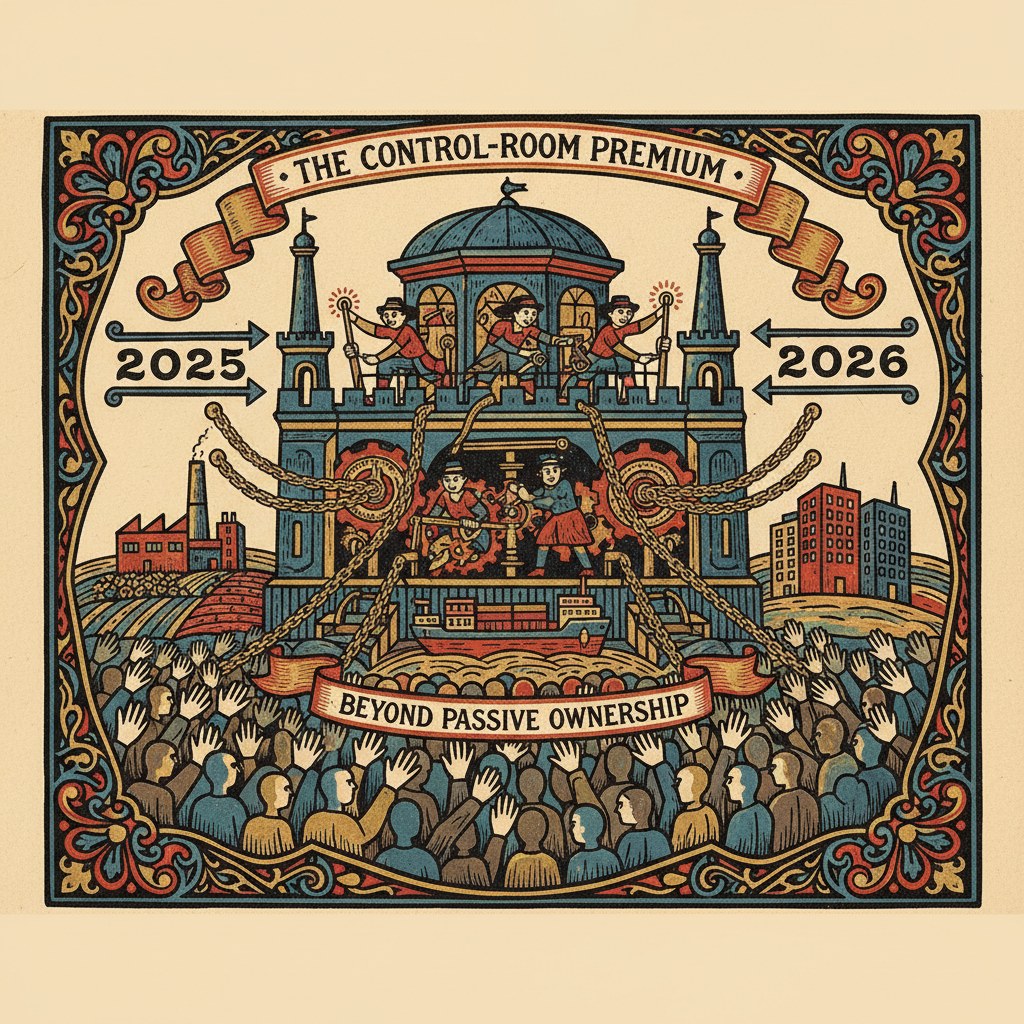
Editorial figure: The report's market-transmission and investment logic rendered as a visual framework; the illustration does not represent measured data.
The Competitive Field
The evidence ledger does not identify public issuers with verified tickers, market capitalizations, operating metrics, or securities data sufficient for a conventional company ranking. That limitation prevents a defensible leaderboard. It does not prevent comparison of the competing operating models forming around real-asset ownership and management.
The field is better understood as a contest among architectures. One model keeps ownership, operations, maintenance, projects, and data relatively separate. Another seeks lifecycle integration across a portfolio. A third modernizes the investor-facing ownership layer through tokenization and automation.
| Company | Ticker | Market Cap | Key Metric | Vetta Signal |
|---|---|---|---|---|
| Passive ownership model | Not verified | Not verified | Economic exposure remains separated from much of the operating chain | WATCH: assess delegated controls and information access |
| Integrated asset-management platform | Not verified | Not verified | Lifecycle coordination across projects and operational assets is the core design principle [14] | WATCH: strongest fit with the control-room thesis, pending issuer evidence |
| Climate-risk-adjusted asset-health system | Not verified | Not verified | Combines asset condition, continuous risk analysis, remaining-useful-life analytics, and climate context [11] | WATCH: decision-support potential, but model quality and adoption remain unverified |
| Tokenized real-estate or RWA platform | Not verified | Not verified | Liquidity, automation, participation, architecture, compliance, and institutional readiness are central variables [15][18] | WATCH: ownership innovation is not a substitute for physical operations |
The table is deliberately sparse because false precision is theater. No supplied source verifies a ticker or market capitalization for these entries. The relevant comparison is structural.
Integrated Lifecycle Platforms: Positive Strategic Impact
The integrated platform has the clearest connection to the central thesis; Research on relationally integrated value networks identifies practical potential for total portfolio management across ongoing construction projects and operational built assets. [14] This matters because lifecycle decisions are economically linked even when they are administratively separated.
A connected platform may compare competing capital needs on a portfolio basis. It may link project choices to future operating consequences. It may preserve institutional knowledge when a project moves into operations. It may also make risk visible before it becomes an emergency procurement event.
The climate-adjusted asset-health framework offers a more technical version of the same advantage. Its proposed approach combines sensor networks, remaining-useful-life analytics, risk-aware planning, and climate vulnerabilities in asset-health assessment. [11] If implemented with reliable data and clear accountability, that structure could improve maintenance and resilience prioritization.
The qualification matters; The evidence describes a framework and its rationale, not audited proof of financial outperformance. The positive signal is strategic coherence, not verified equity alpha.
Passive Ownership: Negative Strategic Impact
Passive ownership is not inherently weak. It may be efficient when an asset is simple, operating partners are capable, contractual rights are clear, and owners retain credible oversight. The negative impact appears when economic ownership becomes separated from the information and authority needed to manage an evolving risk profile.
The railway evidence is relevant because it emphasizes the challenge of turning diverse data into cohesive, risk-prioritized decisions; [11] A passive owner can receive reports, but reports are not the same as integrated decision-making. If the owner lacks access to condition data, maintenance rationale, or climate-risk assumptions, problems may become visible only after downtime, costs, or insurance consequences emerge.
The lesson is not that passive capital should own nothing; It is that passive capital should demand a clearer map of who operates the control room and who is accountable when it fails.
Tokenization Platforms: Mixed Strategic Impact
Tokenization platforms have a credible claim on the ownership side of the equation. The available research suggests that liquidity, smart-contract automation, and decentralized participation can shape psychological ownership and user satisfaction. [15] Comparative research also treats tokenization as part of long-term capital-market modernization. [18]
The negative side is fragmentation; Architecture, regulatory compliance, and institutional readiness vary across platforms, complicating platform selection and implementation. [18] A tokenized claim can also distract investors by directing attention toward transferability and interface design while physical condition, cash-flow governance, and maintenance liabilities receive less scrutiny.
The skeptical conclusion is simple. Tokenization may change access, settlement, and participation. It does not independently validate the asset or its operator.
Data-Infrastructure Providers: Enablers, Not Automatic Winners
The evidence ledger includes material on industrial-grade Linux, AI-ready data infrastructure, integrated data systems, AI-driven scientific storage infrastructure, and platform engineering. [1][2][3][4][5][6] These references support the relevance of infrastructure-grade computing and data systems across research and enterprise settings. [1][2][3][4][5][6]
They do not establish a direct revenue bridge to a specific real-asset owner or operator. The competitive relevance is enablement. Real-asset platforms may increasingly require secure, durable, interoperable systems to operate their control rooms, but a technology provider’s relevance does not automatically make it the best investment expression of the real-asset theme.
The competition is therefore not merely company against company; It is operating model against operating model. The stronger model will be the one that connects physical evidence to financial decisions without building an opaque tollbooth around essential information.
Investment Thesis
The investment thesis is not that vertical integration always wins; It is that the quality of integration is becoming more important to real-asset durability as assets face aging, climate-related risk, data complexity, and pressure to coordinate capital across portfolios. [11][14]
The bull case rests on three linked propositions. Integrated lifecycle management can improve the connection between project decisions and operating outcomes. [14] Risk-adjusted asset-health systems can help prioritize action across aging assets and climate-related vulnerabilities. [11] Integrated data infrastructure is also receiving institutional support in AI-driven research settings, reinforcing the broader importance of data systems as infrastructure. [2][3][5]
Together, these propositions suggest a potential control-room premium. A platform that sees more of the asset lifecycle, converts signals into ranked decisions, and retains authority to act may reduce costly handoffs and improve capital discipline. The supporting evidence remains conceptual and operational rather than security-specific.
Bull Case
The bull case is strongest where physical complexity and information fragmentation are high. In those settings, a connected platform may avoid reactive maintenance, improve portfolio-wide prioritization, and link resilience spending to operating evidence. [11][14]
A second bull argument comes from vertical-ownership theory. The referenced model finds that forward ownership can mitigate double marginalization and increase aggregate output under stated assumptions. [10] The infrastructure inference must remain modest: aligned ownership can sometimes reduce coordination friction that separate entities would otherwise preserve.
Bear Case
The bear case is equally credible; Integration can create complexity, fixed costs, management sprawl, and conflicts of interest. Research on vertically mixed markets warns that competition outcomes, ownership levels, R&D, and welfare effects vary with market conditions, while also pointing to antitrust scrutiny of ownership and coordination. [16]
A platform may also overestimate the value of its own data. Asset-pricing research warns that underestimating discount-rate volatility can produce mispricing. [22] If investors treat data visibility as proof of lower risk, they may underprice financing, regulatory, climate, and execution uncertainty.
Conviction and Valuation Limits
Conviction is moderate at the structural level and low at the security-selection level. The structural case rests on evidence that integrated asset management and risk-adjusted monitoring can improve the organization of lifecycle decisions. [11][14]
The security-level case cannot be completed from the ledger. It does not verify issuers, tickers, market values, revenue, margins, leverage, backlog, free cash flow, or company-specific operating results. No justified multiple, target price, market-cap comparison, or return forecast can be derived.
The appropriate valuation question is qualitative but demanding: does the platform’s integration produce measurable operating outcomes that exceed its added complexity and capital burden? Without evidence of that outcome, investors should not assign a premium merely because the organization controls more of the value chain.
Catalysts and Invalidation Conditions
Potential catalysts include wider deployment of integrated data systems, greater attention to climate-risk-adjusted maintenance, and institutional movement toward lifecycle portfolio management; [2][3][11][14] These are thematic catalysts, not verified company events.
The thesis is invalidated where integration fails to improve maintenance prioritization, project-to-operations handoffs, data reliability, or accountability. It is also weakened where apparent advantage depends mainly on restricted data access rather than better physical-asset outcomes. In the signal-box metaphor, a room with no reliable track information is not a control room. It is an expensive room with blinking lights.
Challenges & Risks
The first risk is conceptual overreach; It is easy to observe that infrastructure is becoming more data-intensive and conclude that every integrated platform deserves a premium. The evidence supports the need for cohesive risk prioritization, lifecycle coordination, and AI-ready data infrastructure. [2][3][11][14] It does not provide audited proof that integration reliably produces superior investor returns.
Execution risk follows; The railway framework combines sensor networks, analytics, risk management, and climate context. [11] Every component can fail: sensors can be incomplete, models can misclassify risk, data can arrive late, teams can ignore recommendations, and capital committees can defer necessary work.
A technically impressive platform that is operationally ignored creates little value. Worse, it can create false confidence by producing formal risk scores without changing incentives or funding decisions. The investor should ask not whether the platform has a dashboard, but whether its findings alter decisions when those decisions are expensive.
Governance and Agency Risk
Vertical integration can reduce handoffs, but it can also concentrate power. The literature on forward passive ownership and vertically mixed markets shows that ownership structures can affect prices, output, competition modes, welfare, and incentives in ways that depend on assumptions and market conditions. [10][16]
There is no general rule that more ownership alignment is always socially or financially superior. Governance determines whether the integrated system creates accountability or simply moves conflicts inside one larger organization. The risks include related-party decisions, weak challenge functions, opaque data rights, and incentives to protect reported performance rather than address underlying asset condition.
For investors, diligence should examine governance before admiring architecture. Who can challenge model outputs? Who approves major capital projects? Who owns the data when operating contracts change? Who is accountable when optimization conflicts with resilience or service quality?
The ledger does not provide answers for individual issuers. That absence is itself a risk flag.
Climate and Physical-Risk Uncertainty
Climate-aware asset health is a useful analytical direction, but climate exposure is not a one-time input. The cited framework identifies heat buckling, flood and scour, and windstorm debris as relevant vulnerabilities for railway infrastructure. [11] Conditions, thresholds, and interdependencies can change.
A model calibrated to historical patterns may become less useful when operating conditions shift; Investors should not treat a climate-risk score as a final answer. It is a starting point for examining assumptions, maintenance capacity, contingency planning, and the ability to act when the score changes.
Regulatory and Institutional-Readiness Risk
Tokenization carries a different risk set. The real-world asset tokenization comparison emphasizes fragmentation in platform architecture, regulatory compliance, and institutional readiness. [18] An ownership innovation can therefore be technically functional while still proving difficult to scale or govern inside existing institutional structures.
The tokenized-real-estate study focuses on user perceptions and continuance intention rather than infrastructure operating performance. [15] A favorable participation experience should not be mistaken for evidence of asset quality, maintenance discipline, or durable cash flow.
Valuation and Discount-Rate Risk
The asset-pricing evidence on underestimated discount-rate dynamics is especially relevant to long-duration assets; [22] A platform narrative can tempt analysts into a flawed chain of reasoning: better data implies lower risk, lower risk implies a lower discount rate, and a lower discount rate implies a higher valuation.
That chain may fail at every stage. Better data can reveal risk. More integration can require more capital. More control can bring more liability. Increased visibility may make cash flows appear less stable before it makes operations more resilient.
KEY TAKEAWAY: The central risk is not that integration fails visibly; it is that investors price invisible complexity as though it were proven resilience.
The Investment Angle
The investable expression of this theme is selective and evidence-constrained. The ledger supports a WATCH posture on integrated real-asset operating models, climate-adjusted asset-health frameworks, and tokenization platforms that can demonstrate institutional readiness. It does not support verified LONG or SHORT recommendations in named securities.
That is not indecision. It is the appropriate conclusion when issuer-level evidence is missing.
What Merits Attention
The strongest candidates would demonstrate four linkages. They would connect physical-condition evidence to maintenance decisions. They would connect maintenance decisions to portfolio capital allocation. They would connect construction and renewal projects to later operating accountability. They would connect digital ownership or reporting systems to verified underlying-asset governance.
The cited research supports the relevance of each linkage. Railway asset-health work supports the condition-to-risk-to-planning chain. [11] Relationally integrated value networks support the project-and-operations portfolio perspective. [14] Tokenization research supports the importance of liquidity, automation, participation, architecture, compliance, and institutional readiness. [15][18]
The next step is to demand evidence that these links work in practice. A platform should be able to show how risk outputs changed a maintenance decision, how project choices altered later operating obligations, and how data ownership remains auditable when counterparties change.
A Diligence Scorecard
| Test | Evidence to Request | Why It Matters |
|---|---|---|
| Asset visibility | Condition records, sensor coverage, data-quality controls, and risk thresholds | Determines whether the control room sees evidence rather than noise [11] |
| Decision linkage | Examples showing how risk outputs changed maintenance, renewal, or capital allocation | Separates analytics from action [11] |
| Lifecycle integration | Governance across construction projects and operating assets | Tests total portfolio management rather than siloed optimization [14] |
| Climate context | Treatment of heat, flooding, scour, wind, and related vulnerabilities where relevant | Tests whether physical resilience enters decision-making [11] |
| Ownership architecture | Rights, obligations, transfer rules, compliance processes, and institutional readiness | Tests whether tokenization improves access without weakening governance [15][18] |
| Valuation discipline | Assumptions for discount rates, capital needs, and operating-risk volatility | Guards against narrative-driven mispricing [22] |
This scorecard does not create an automatic buy signal; It creates a way to investigate whether a platform owns the right parts of the problem, rather than merely the most visible parts.
LONG, SHORT, and WATCH
LONG: No named LONG is supported. The ledger does not verify a public issuer, ticker, valuation, financial metric, or company-specific catalyst.
SHORT: No named SHORT is supported; The ledger does not verify a public issuer, valuation excess, balance-sheet weakness, or company-specific adverse catalyst.
WATCH: Integrated infrastructure and real-asset platforms that can demonstrate lifecycle coordination. [11][14] Risk-adjusted maintenance, credible data governance, and accountability across projects and operations. [11][14]
Listed options are not verified in the evidence ledger; No options spreads should be inferred or constructed.
Implementation Risks
The implementation risk is that the theme becomes too broad. Infrastructure software, asset managers, sensor suppliers, tokenization venues, data-storage providers, and physical operators may all appear adjacent to the same story while possessing very different economics.
The ledger includes references to industrial-grade Linux, AI-ready data infrastructure, integrated data systems, AI-driven storage infrastructure, and platform engineering; [1][2][3][4][5][6] Those references do not establish that every adjacent business benefits equally from the control-room thesis.
The practical approach begins with the physical asset and works backward; What can fail? What evidence detects the failure? Who decides what to do? Who pays? Who captures the benefit?
If those answers remain vague, the platform claim is not yet investable. The control-room premium should be earned through evidence of fewer unplanned failures, better capital prioritization, stronger handoffs, clearer accountability, or more credible resilience planning. Without that proof, “vertical integration” is a label rather than a thesis.
Future Outlook
The future of real-asset investing may be defined less by a clean break from passive ownership than by a higher standard for what passive owners must understand; Capital can remain financially passive while demanding deeper visibility into maintenance logic, climate exposure, operating data, and lifecycle capital planning. The ownership claim may stay passive; the diligence cannot.
Integrated platforms may receive greater attention because the underlying problems are stubborn. Aging infrastructure, climate-related risk, scattered data, and disconnected project-to-operations handoffs do not disappear when an asset changes hands. [11][14] They require institutions capable of turning evidence into action.
The data-infrastructure trend adds momentum. Federal and research institutions are investing in integrated, AI-ready systems, while research organizations describe storage infrastructure as enabling capacity for AI-driven work. [2][3][5] The inference for real assets is not that every operator becomes an AI company. It is that operating competence may increasingly depend on the information architecture behind the physical asset.
Tokenization will remain relevant on a separate track. It can reshape participation, transferability, and ownership experience. [15] Its institutional path remains constrained by fragmentation across architecture, compliance, and readiness. [18]
The platforms that matter most will be those that connect the investor-facing rail line to a credible operating rail line beneath it. The decisive question is not whether infrastructure becomes digital. The supplied evidence shows AI-ready data systems, platform infrastructure, and digital-ownership research across infrastructure-related settings. [1][2][3][4][5][6][15][18] The decisive question is whether those systems create a clearer chain of responsibility from signal to decision to outcome.
That chain determines whether integration creates a durable advantage or simply a more elaborate organizational chart. Ownership-structure research suggests that coordination can alter incentives and output, while research on vertically mixed markets warns that these effects are conditional and demand scrutiny. [10][16]
The strongest real-asset platforms may not be those that claim to own everything. They may be those that know which decisions must be integrated, which relationships should remain independent, and which evidence must remain auditable. In the signal-box metaphor, the goal is not to control every train. It is to know which signal matters, who has authority to change it, and what happens if nobody does.
Sources & References
- Linux Foundation. "Civil Infrastructure Platform: Industrial Grade Linux at 10 - Linux Foundation." Mon,. https://news.google.com/rss/articles/CBMijwFBVV95cUxNc1dZWE12SHJsX3RFWkozaUhreVBoaXBHQzNmYW9CWWkxemE2djhUUllJS01iOXZ0MzVKOUkzYU5VdHdUa2xhb09LMDZ5czZ5T3BFUDFzSUViX0tXc3l3Rkk2SXZMWUFvb1Y4WTdKRDd3Sjl6Y2JEWFF3ZGh3REhKbmdfNEk5ajZ4WkdFcW85RQ?oc=5
- UC San Diego Today. "National Data Platform Receives NSF Category I Award to Expand AI-Ready Data Infrastructure for U.S. - UC San Diego Today." Mon,. https://news.google.com/rss/articles/CBMixwFBVV95cUxQYVhkWjlzZDd2UHFjNmF4QzQ4a2R1OVNmdWxacGVFUldMV3NYRkdPQkd5UWlERVBoMUhTbUV5dGVLUmRldnF3dFJNU1JFYTFJbjBqWWJYcEprRnhMczktQkdkNW9zREJVUlhTQVN4NmZEUnVHXzFKbUxCX0VjdWFJa1ZjQThQX0dBd0VjNEMxbUpxZHh5Q2duQUFmbVVjQVQwdHpYVW50Tk5UcEctUnNEV1Y4aXFJa2hONFpNNXkyMlNNLWhqZlI0?oc=5
- U.S. National Science Foundation (.gov). "NSF announces $83M investment in integrated data systems and services to advance AI-driven science and strengthen U.S. research infrastructure - U.S. National Science Foundation (.gov)." Wed,. https://news.google.com/rss/articles/CBMigwFBVV95cUxQTjhFTkJnNG1TZEdQZTBWTXRzUHNxNXZMMGx5VVNxdGxwZkNtSk1PWno2a2FzRy1zVlNCTTJwYUpnOVBnanRLbERtaWVqWHQyYTRqX3RLQ21yZng2c1NNdWg4QW5JVTNzZ3d6bFJGbE55SWg2LTBYcm1xc1J1NjYyMFRHQQ?oc=5
- Broadcom. "451 Research: Broadcom positions VCF as the infrastructure substrate for Platform Engineering 2.0 - Broadcom." Tue,. https://news.google.com/rss/articles/CBMi2gFBVV95cUxPZHREUDRvMmVMN0lVUUgxMEhTNHd5NjlWNExhN3pERDVvZ19ia1BBWV9rOU92bUFVWWt6eUdvSmJSYUtQVnJyYjlmd3haOGNxZHU5UFlWMndiYWEtYTd5N2NkSXJQQ2FTNkJ6WnIyRmJmVjNJd1NIcGlFcjN2bDhUWEVpVlVMMTRFWGFEblpkWnRDMUVXUnZ6QjZWQ0RITjVXWkloYTljaWFfc1o5cXlqaVl2VFJ5Y3VIOGFoYWZ2Y3JMOVFhTkF3N2VKbHBSZE9JbUJQeV9hOUlKUQ?oc=5
- Fermilab (.gov). "Fermilab storage infrastructure enables AI-driven scientific and research discovery for DOE’s Genesis Mission - Fermilab (.gov)." Thu,. https://news.google.com/rss/articles/CBMi1gFBVV95cUxPRHo1U2ZkbXFiSGdSSDRuaHpZa254dm5pSHhjLXg1LUg5bXhVVnNQanBLU0JXUENCSXY4dkU1dU56bWdidXl6dTFFVWxwVThyamFSdXBLQUx6VUdkYkFUdXRRXzhic1dqNFhSNXdMYzBSdXFzU2d1SFBGNU1SNEZqcTBsWmN2SHFNcE9XTWg0M2JtVlRRRk9ITEx5MzV3UlhqTGNnMWJoRm1UMl9VcXNnanlGSFRDREZ0clJlemx1REpaREx5N05BcnVkOXJmNGxMelV1cGl3?oc=5
- Linux Foundation. "A Decade of Industrial Grade Linux: How the Civil Infrastructure Platform Is Securing Mission-Critical Systems - Linux Foundation." Tue,. https://news.google.com/rss/articles/CBMi3wFBVV95cUxPdkZHaWFhRFYzRnJVUkNXQ3cwSndlWTF1dHJVaTlXcjROQ0l6WDRweUhZYUZ0M2Vid0JjdkZuRmhyQnFjMUtyM0J5S1hVbWk5RXV1Tm5hMDBVc2hMQWFQVHVHdlZlNEtpS1V2UjByb0lrUF9RNUpsd3JjSnN3U2hLa1U4cmt0Q1N0WFZSODVRdW5uTHVhRHc1QkhZSmx2SWdpc2I5Q0x2UzZPT3NlQXdOSEpmbk1pd1VRWlU2MldQVTdsTXZPZTduZHNHMjk2LVFoRW1OZlBGUEszaGhWZ0ZJ0gHvAUFVX3lxTE5UNFdncTh2QmdfWkRWalItM2JnN2xjTmtZdW51aXl1UnVJSEF1Wkh5OHVMSER5U0pvRzNOYVUwUy1temdsNGo3b3Y5ZDJTV3ZRYmVoTXlXZjV2QnAxNzBHNW5YVDQ0eG5nTTF5SGw3ZGFHMVozWEVJVW5TR1p0YzFvM2VkNk9YQmNFX04ta2VwTjFiSjBSZTB4YlBaRUlaOTlzNWthcDhsYm1aODA5RGZjN0R2RWlOMi0weFN2ZUZoa1ppYmNSaG9IazJoNExDVWZFWTRlNU5ma3k2a0U5OHdQS25xZXR3WF9VMDJoV0JZ?oc=5
- The National Law Review. "Latest Embedded Finance And Fintech Infrastructure Platform Market Research By The Business Research Company - The National Law Review." Sun,. https://news.google.com/rss/articles/CBMitgFBVV95cUxPYm55a1VSblVLRF84UDNwNk8xT3c2NmotMDdMQXU4YnZYaktoNTFkQ0hnVzR0ZER2bjJYTmZxTHozT19Jdjh2YWlCQjNQc3RvU0dBdjFuX3YyRXA5b2ZNaWFQcmlNaVJwTkpZR1BEY0pudjJfOGdMY0J6VWJjdG5rLW5HUUJvQmhOS3RVWnQ3Wk5MdEZQaHJNci1uQ1pRSUZCejhxMjhzZzhDMXI5VUJZRkN3cGhKUQ?oc=5
- Frontiers. "BRI DataLab: an AI-assisted research platform for Chinese infrastructure finance - Frontiers." Fri,. https://news.google.com/rss/articles/CBMijwFBVV95cUxONXJUdkNXTFJqMDV1bjBrVFVWVjJ1MnVwQ2dsN0hDMkNYYlhuc2hSci1MV2lnVGFjVVVlVWVQNkliVVRna2NQVzlHSEJWa243ZTFQTnBHSER2RUhHWlNtTjgzMHFKMkJrSV9sY245endrOE1hbWdTVUpFTVlTMXJNRXpkWWJCek9LZE9PalVSUQ?oc=5
- Energy 360. "The urban shading paradox: Why vehicle-integrated photovoltaics must pivot from range extension to asset protection." 2026. https://doi.org/10.1016/j.energ.2026.100083
- Games. "Passive Partial Forward Ownership and Strategic Trade Policy in Vertically Related Industries." 2026. https://doi.org/10.3390/g17050053
- Journal of Cultural Analysis and Social Change. "A Climate‑Risk‑Adjusted Asset Health Index Framework for Railway Infrastructure: Integrating Wireless Sensor Networks, Prognostics, and Intelligent Asset Management Platforms." 2026. https://doi.org/10.64753/jcasc.v11i1.4170
- Infrastructure Asset Management. "Infrastructure Asset Management : Reviewers 2025." 2026. https://doi.org/10.1680/jinam.2026.13.1.83
- Iconic Research and Engineering Journals. "Leveraging AI for Real-Time Compliance Monitoring in Brokerage and Asset Management Platforms." 2026. https://doi.org/10.64388/irev10i1-1720027
- Infrastructure Asset Management. "Relationally integrated value networks for total asset management in project portfolios." 2022. https://doi.org/10.1680/jinam.19.00059
- Built Environment Project and Asset Management. "Antecedents and consequences of psychological ownership in tokenised real estate markets." 2026. https://doi.org/10.1108/bepam-10-2025-0307
- The Manchester School. "Endogenous Competition Strategies With R&D in a Vertically Mixed Market Under Forward Passive Ownership." 2025. https://doi.org/10.1111/manc.70019
- Urban Matters. "Digital Platforms as Urban Infrastructure?." 2026. https://doi.org/10.24834/urbanmatters.2026.04.1
- World of Finance. "COMPARATIVE ANALYSIS OF REAL-WORLD ASSET TOKENIZATION PLATFORMS AS A METHODOLOGICAL BASIS FOR INSTITUTIONAL IMPLEMENTATION." 2026. https://doi.org/10.35774/sf2026.02.102
- Knowledge-Based Systems. "Fractional digital asset ownership–an intelligent fractional NFT-based approach to the reliable provenance of digital asset co-ownership." 2026. https://doi.org/10.1016/j.knosys.2026.115631
- Structure and Infrastructure Engineering. "Asset management for storm surge barriers: how and why?." 2024. https://doi.org/10.1080/15732479.2024.2391034
- Critical Sociology. "From human capital to asset ownership: AI as rentier asset." 2026. https://doi.org/10.1177/08969205261461604
- The Review of Asset Pricing Studies. "Asset Prices When Investors Underestimate Discount Rate Dynamics." 2026. https://doi.org/10.1093/rapstu/raag005
- Infrastructure Asset Management. "Infrastructure Asset Management: Referees 2023." 2024. https://doi.org/10.1680/jinam.2024.11.1.56
- Infrastructure Asset Management. "Infrastructure Asset Management: Reviewers 2024." 2025. https://doi.org/10.1680/jinam.2025.12.2.129
All sources were verified at the time of publication.
Disclaimer: The information provided in this article is for educational and informational purposes only and does not constitute investment advice, a solicitation, or a recommendation to buy or sell any security; Vetta Investments does not guarantee the accuracy, completeness, or timeliness of any information presented.
Past performance is not indicative of future results. All investments involve risk, including the possible loss of principal. Readers should conduct their own due diligence and consult a qualified financial advisor before making any investment decisions. Vetta Investments may hold positions in securities mentioned in this article.